October 13, 2026
Cosmetology State Board Exam Guide: What to Expect and How to Get Ready
The cosmetology state board exam has two parts: a written test covering theory (100 to 150 multiple-choice questions) and a practical test where you perform services on a live model or mannequin, and most states set the bar at 75 percent on each section. It comes after your training hours are complete, so by the time you sit for it, you have already spent months building the skills it measures. At PJ’s College of Cosmetology, that training runs 1,500 hours across cosmetology, esthetics, nail technology, and instructor programs at 11 campuses in Indiana and Kentucky, with instructors who build exam review into the curriculum itself and structured study time built around it. Indiana and Kentucky both test through the National Interstate Council of State Boards of Cosmetology (NIC), so the format below reflects what candidates at PJ’s campuses actually sit for.
What is on the cosmetology state board exam?
Most state board exams have two components: a written test and a practical, hands-on test. The written portion runs 100 to 150 multiple-choice questions over 2 to 3 hours and covers theory. The practical portion has you perform specific services, like a haircut, color application, or a facial, on a live model or mannequin while an examiner watches your technique and sanitation practices.
Nationally, 60 to 80 percent of candidates clear the exam on their first attempt. Most states set the required minimum score at 75 percent on both the written and practical sections, though the exact threshold varies by state. Indiana and Kentucky both administer standardized testing through the NIC, but each state still sets its own rules for eligibility, content emphasis, and licensing requirements, so confirm the specifics for the state where you plan to work.
What’s on the written cosmetology exam?
The written exam draws from five main content areas: general sciences (anatomy, physiology, chemistry, and bacteriology), hair services (cutting, styling, coloring, chemical treatments, and hair structure), skin and nail services (facials, makeup, manicures, pedicures, and nail structure), sanitation and safety (infection control, sterilization, and OSHA standards), and salon business (professional ethics, client consultation, retail, and management). Hair services typically make up the largest share of the exam, which tracks with cosmetology being a hair-focused license.
- Sanitation and infection control: the difference between sanitation, disinfection, and sterilization; proper tool cleaning; bloodborne pathogen protocols; and sanitized tool storage.
- Hair chemistry: pH levels and their effect on hair, oxidation and reduction reactions, levels and tones in color theory, developer strengths, and chemical incompatibilities.
- Anatomy and physiology: hair structure, skin layers, nail structure, blood circulation as it relates to services, and the musculature and bones of the head, face, neck, arms, and hands.
- State laws and regulations: licensing requirements, scope of practice, prohibited practices, salon operation rules, and the responsibilities of both client and practitioner.
Questions are multiple-choice with four answer options. Some are straightforward recall, others are application scenarios that ask you to make a professional judgment call, and a portion include diagrams or images you have to identify.
How do you study for the written exam?
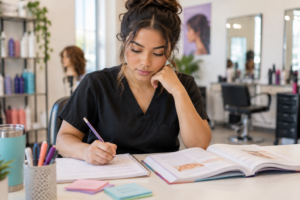
- Build a study schedule. Plan on 4 to 6 weeks of consistent, regular sessions of 45 to 60 minutes rather than a few long cram sessions right before the exam.
- Mix your study methods. Read and highlight your textbook, build flashcards, take timed practice tests, join a study group, watch technique videos, and sketch out diagrams or mnemonics for anything that is not sticking.
- Study for understanding, not memorization. Focus on how concepts connect rather than isolated facts. Knowing why a developer strength matters helps you reason through a question you have not seen before.
- Take practice exams seriously. Simulate real test conditions when you take them, and review the questions you guessed correctly along with the ones you missed, since a lucky guess still points to a gap.
- Track your weak areas. Keep a running list of the topics that trip you up and put extra study time there instead of spreading your review evenly across everything.
What happens during the practical cosmetology exam?
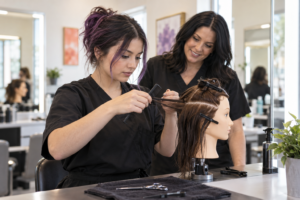
The practical exam has you complete a set of services drawn from a larger pool of possibilities, commonly haircuts, chemical services, hair coloring, scalp treatments, hair styling, facials, manicures, and pedicures. Some states assign the same services to every candidate; others rotate which services each candidate draws.
- Your model: most states require you to bring your own live model who meets specific requirements: hair that is usually at least shoulder length, chemically untreated hair for certain services, appropriate texture and condition, and a minimum age (typically 18). Pick someone reliable and run through a consultation with them before exam day.
- Your kit: sanitized tools (combs, brushes, scissors, clips), towels, capes, and linens, the specific products your exam requires (shampoo, conditioner, color, developer, and similar), disinfectant and sanitation supplies, and protective equipment. Prepare and label your kit well in advance. A disorganized kit costs candidates points they otherwise had the technical skill to earn.
- Sanitation and safety: examiners watch this throughout the exam. Proper draping, disinfecting your workstation, pulling tools from closed, sanitized containers, wearing gloves correctly, cleaning up spills immediately, and keeping an organized station all count.
A useful frame for the practical exam: treat it like a service in a professional salon with a health inspector standing over your shoulder.
Deductions most often come from sanitation violations, unsafe chemical handling or tool use, skipped or out-of-order steps, uneven product application or incorrect mixing ratios, technical errors like uneven cutting or improper sectioning, and running out of time on a service. Work through each service methodically: set up your sanitation station first, mentally walk through your plan, keep a steady pace, follow the procedure in order, check your work at natural stopping points, and stay professional if something goes sideways. Examiners are evaluating overall competence, not a flawless run.
What study resources help you get ready?
A mix of resources covers both the written and practical exams better than any single one on its own.
- School-provided materials: your cosmetology school’s textbooks include review chapters, and instructor-led review sessions, practice tests, and study guides are usually built around what has tripped up past candidates. Take the review sessions seriously; they are pointed at your state’s exam specifically.
- State board review books: Milady’s Standard Cosmetology Exam Review and the Pivot Point Cosmetology State Board Exam Review are the two most common options, each with a full content review, hundreds or thousands of practice questions, answer explanations, and test-taking strategy sections.
- Online practice tests and apps: look for one built for your specific state’s exam, with updated content, explanations for each answer, and a real volume of questions (several hundred at minimum) rather than a short sample set.
- Video resources: especially useful for the practical exam, since watching a technique demonstrated correctly, more than once, reinforces it differently than reading about it.
- Study groups: organize a regular meeting with 3 to 5 committed classmates. Quizzing each other, explaining concepts out loud, and practicing techniques together works partly because teaching a concept back to someone else is one of the fastest ways to find the gaps in your own understanding.
What test-taking strategies help on exam day?
- Manage your time: calculate roughly how much time you have per question going in. Do not sink extra minutes into one hard question; mark it and come back. Most exams do not penalize guessing, so answer every question.
- Work through multiple-choice questions deliberately: read the full question before looking at the answer choices, and try to anticipate the answer before you see the options. Eliminate the choices you know are wrong first. Watch for absolute words like “always,” “never,” and “only,” which often signal a wrong answer, and read negative questions (ones asking what NOT to do) twice.
- Handle the questions that stump you: look for clues inside the question itself, use context from other questions on the test, apply common sense from your training, and trust your first instinct if you studied well. An educated guess beats a blank answer every time.
- Manage exam-day nerves: solid preparation is the real fix, but positive self-talk, visualization, deep breathing, a full night of sleep, a real breakfast, and arriving early so you are not rushed all help in the moment. The exam is confirming knowledge you already built over 1,500 hours of training, not testing you cold.
How should you prepare the week before your exam?
- Final review: spend the last week reviewing your weak areas, taking full-length timed practice exams, and going back over the mistakes you have already made. This is not the week to learn new material.
- Practical run-throughs: practice each service you might be assigned more than once, timing yourself to confirm you finish within the limit. Double-check your kit is complete and sanitized, and confirm your model still knows what the appointment involves.
- Logistics: confirm your exam date, time, and location, map your route with traffic in mind, gather your required documentation, and pick out professional attire. Arrange childcare or time off work early rather than the night before.
- Self-care: keep a regular sleep schedule, eat well, exercise to manage stress, and ease off caffeine. How you feel physically shows up in how you perform.

What should you do on exam day?
Wake up with time to spare, eat a real breakfast, dress professionally, do a light review without cramming, and get to the test site early.
- What to bring: valid photo identification, your exam confirmation documents, your prepared kit and model (for the practical), a writing implement if needed, and water or a light snack if the site allows it.
- During the written exam: read every instruction carefully, answer the easier questions first, then circle back to the harder ones, and keep breathing steadily.
- During the practical exam: follow your procedures in order and stay focused on one step at a time rather than the clock.
- After the exam: skip the post-exam debrief with other candidates comparing answers. It rarely helps and often just adds stress. Take a minute to recognize that you finished, whatever you think of how it went.
What happens after you sit for the exam?
Your score report breaks down your overall result and your performance in each content area. Candidates who meet the required score move on to the license application. Candidates who do not can see exactly which content areas were weak, which points directly at what to study before retesting.
Not clearing the bar on the first attempt is not the end of the road. Plenty of working professionals needed a second attempt. If that happens, go back through your score report, put your study time into the specific weak areas it flags, take more targeted practice tests, and talk to an instructor about tutoring if a particular topic is not clicking. Address test anxiety directly if that was part of it, and only schedule your retest once you are actually ready.
What comes after you get your cosmetology license?
Once you meet the required score on both the written and practical sections, you apply for your license through your state board with your official exam results, proof of completed training hours, the application and its fee, and passport-style photos.
- Update your resume: and start applying to salons, spas, and other beauty businesses.
- Prepare for interviews: the same way you would for any professional role in the industry.
- Weigh your options: salon employment, booth rental, mobile services, and specialized positions all look different day to day, and your license opens the door to any of them.
- Keep learning: a license is the starting credential, not the finish line. Continuing education keeps your skills current as trends and techniques shift.
Next step: PJ’s College of Cosmetology has trained students across 11 campuses in Indiana and Kentucky for over 40 years, with instructor-led exam review built into the cosmetology, esthetics, nail technology, and instructor training programs. If you are still deciding whether cosmetology school is the right next step, our admissions team can walk you through program length, campus options, and what a typical week of training looks like.
Frequently asked questions
How many questions are on the cosmetology written exam?
Most written cosmetology exams have 100 to 150 multiple-choice questions, administered over 2 to 3 hours, though the exact count depends on your state.
What score do you need on the cosmetology state board exam?
Most states require a minimum score of 75 percent on both the written and practical sections, though the exact required score varies by state.
Do you have to bring your own model for the practical exam?
In most states, yes. Candidates typically provide their own live model who meets requirements around hair length, texture, chemical history, and age (usually 18 or older).
What happens if you don’t meet the required score on your first attempt?
You can retest. Your score report shows which content areas were weak, so you know exactly where to focus before scheduling a retake.
How long is cosmetology training before you can sit for the state exam?
Training hours vary by state and program. At PJ’s College, the cosmetology program includes 1,500 hours of training before a student is eligible to sit for the state exam.